Articles
Why Most Form Builders Break at Scale — And How to Fix It
Category
Category
Product Thinking
Logistics · SaaS · Data Platform
Date
Date
July 2020
July 2020
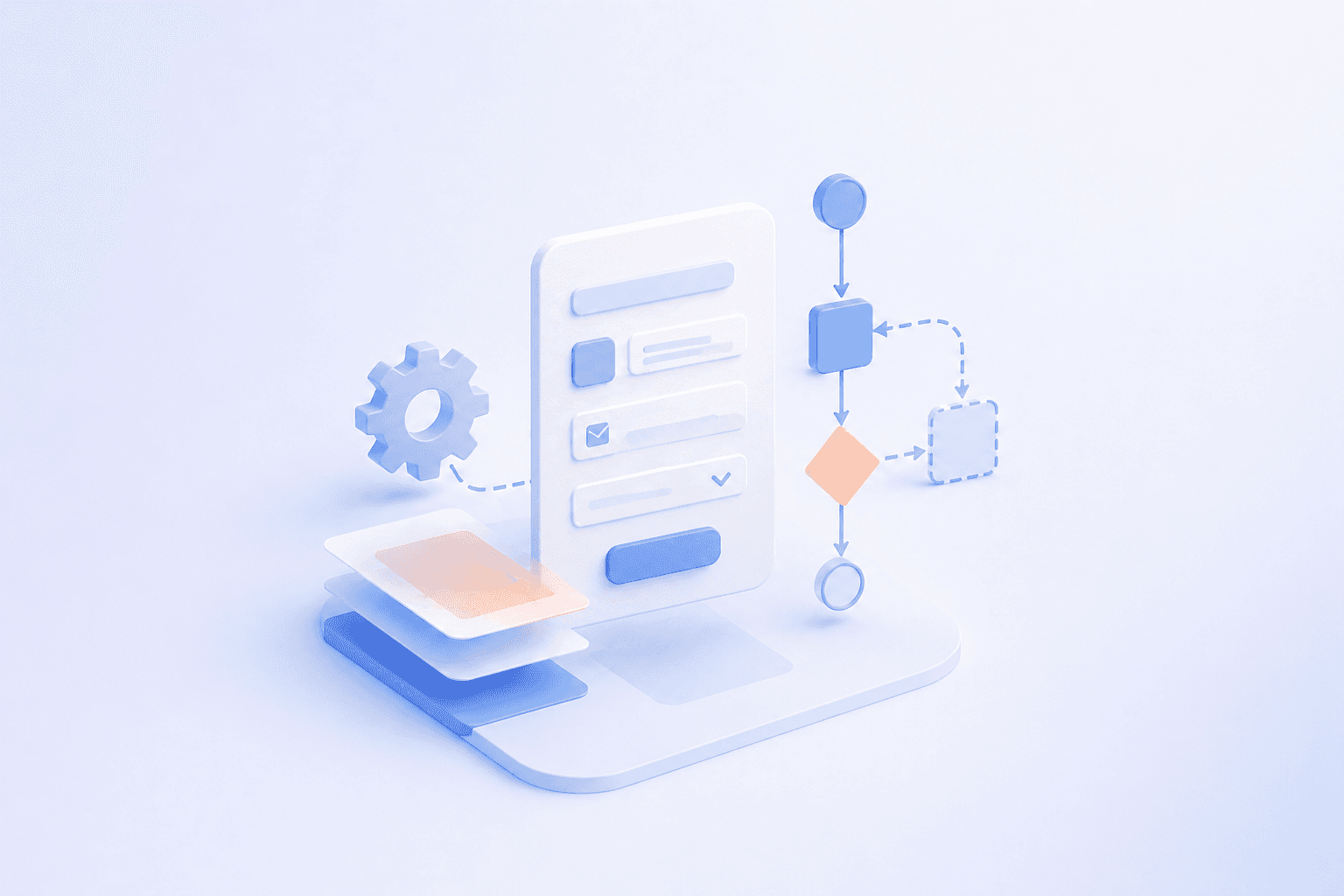
Most form builders work perfectly…
until they don’t.
At the beginning, everything feels simple.
A few input fields, a submit button, maybe a confirmation message.
But real products are never that simple.
As soon as forms start dealing with real users and real data, complexity grows — fast.
Conditional logic.
Multi-step flows.
Edge cases.
Validation rules.
Dynamic states.
And suddenly, what looked like a simple form becomes a system.
Forms Are Not UI — They Are Decision Engines
Most people think forms are just UI components.
But in reality, forms are logic-driven systems.
They decide:
what the user sees next
which path they follow
what data is valid
how errors are handled
Designing forms is not about placing inputs on a screen.
It’s about designing how decisions are made and experienced.
Where Most Form Builders Break
From my experience designing complex, high-frequency user flows, the breaking points are always similar:
1. Conditional Logic Becomes Invisible
As logic grows, users lose track of what’s happening and why.
2. Linear Thinking Fails
Real-world flows are not step-by-step.
They branch, adapt, and evolve based on user input.
3. Error Handling Is an Afterthought
Validation often interrupts instead of guiding the user forward.
4. State Management Gets Messy
A small change in one step can affect the entire flow — often in unexpected ways.
Designing for Complexity (Without Breaking the Experience)
To handle this, we need to shift how we think about forms:
→ From static screens to dynamic flows
Design flows, not pages.
→ From exposing everything to guiding the user
Use progressive disclosure to reduce cognitive load.
→ From error messages to recovery systems
Help users fix issues, not just point them out.
→ From isolated components to system thinking
Every step is connected. Design accordingly.
The Real Challenge
The challenge is no longer building forms.
It’s designing systems that can handle complexity
without overwhelming the user.
Because in real products, simplicity is not given.
It’s designed.
Curious how others approach complex, logic-driven flows in form builders and no-code tools.
#ProductDesign #UXDesign #DesignSystems #SaaS #NoCode #UX
After reviewing many UX portfolios over the years, I’ve noticed a common pattern:
Most portfolios show the final screens. But very few show the thinking behind them.
Beautiful UI is important. But in real products, design decisions rarely come from aesthetics alone.
Real product design involves:
technical constraints
business goals
legacy systems
edge cases
scalability considerations
consistency across flows
collaboration with engineering and product teams
In other words, real design work is often complex and sometimes messy.
That complexity is usually invisible in portfolios.
The strongest portfolios don’t just present polished screens. They make decision-making visible.
They show:
what problem was actually being solved
why a specific flow was chosen
what trade-offs were made
how consistency was maintained across the product
how the solution fits into a larger system